


Elevators are such an integral part of our daily lives that we rarely consider them or think twice about stepping inside and letting the doors close behind us. Elevators have existed since early Greek and Roman history as man-powered hoist and pulley systems, but have advanced along with technology to the electric elevators we know and depend on today. But how safe are elevators? We’ve all seen elevator disasters depicted in Hollywood movies, but how many elevator accidents actually occur, and what types of accidents and personal injuries happen on elevators?
Key Takeaways
Elevator Safety by the Numbers
About 17,000 people suffer elevator-related injuries annually in the U.S., with approximately 30 deaths per year. Far safer than stairs, which cause around 2,000 deaths annually.
Movies Get It Wrong
Modern elevators don’t freefall like in Hollywood films. Multiple safety systems including backup cables, emergency brakes, and shaft stoppers make catastrophic plunges virtually impossible since 1932.
Real Risks Are Different
Most injuries come from door malfunctions, mis-leveling between floors, and sudden movements. Not falling elevators. Falls at the same level while entering or exiting cause over half of all elevator deaths.
Workers Face Greater Danger
Half of all elevator deaths and injuries occur to installation and maintenance workers. Elevator installers have the 6th-highest workplace death rate in construction trades, with falls into shafts being the leading cause.
Children Are The Most Vulnerable
Children are the most common elevator passengers to suffer injuries. In 2022 alone, 117,100 elevators were recalled due to child entrapment hazards.
Prevention Is Possible
Most elevator accidents are preventable through regular inspections, proper maintenance, and adherence to safety protocols. Property owners and employers bear primary responsibility for preventing these incidents.
Quick Links
- List of Elevator Accidents in 2025
- How Often Do Elevators Fall?
- How Many People Are Injured in Elevators Each Year?
- Causes of Elevator Accidents
- Elevator Deaths While Not At Work
- Who Dies on Elevators?
- How Can Elevator Accidents Be Prevented?
- Surprising Statistics on Elevator Accidents
- Who is Responsible for Elevator Hazards?
- Frequently Asked Questions About Elevator Accidents
List of Notable Elevator Accidents in 2025
- On January 26th, a worker fell into an elevator shaft in Savannah, Georgia. Firefighters responded to the incident where the victim was promptly removed with minor injuries. It is currently unknown if a malfunction caused the accident.
- On January 28th, a construction worker in Houston was trapped in an elevator following the collapse of scaffolding at the construction site. An investigation revealed that concrete fell on top of the scaffolding and landed on the elevator box. The man was taken to the hospital in stable condition.
- On January 29th, a psychiatric patient at the West Virginia Department of Health Facilities suffered injuries in an elevator shaft while attempting to flee. The victim was taken to another hospital for medical treatment.
- On February 3rd, a 78-year-old man was found unconscious after falling down an elevator shaft in the Bronx. It is unknown how the man ended up there.
- On February 6th, an electrical technician aged 51 was performing a routine maintenance inspection when he was found with fatal injuries on top of an elevator shaft.
- On February 7th, a 19-year-old concrete finisher fell 17ft to his death in an elevator shaft after leaning on a guardrail.
- On February 28th, a toddler got his hand stuck in an elevator door aboard the Carnival Panorama. The child received treatment on the ship for a laceration. The parents allege that the elevator doors lack sensors to prevent this type of injury.
How Often Do Elevators Fall?
Thriller movies often show an elevator plunging down a long shaft in a freefall, but that type of elevator accident hasn’t happened since 1932 when a cable-operated elevator fell down a shaft in Brazil. Since then, elevators have backup cables, emergency braking systems, and shaft stoppers that don’t allow an elevator to fall down the shaft. However, this doesn’t mean that elevator accidents don’t occur, only that they don’t happen the way they do in movies.
How Many People Are Injured in Elevators Each Year?
According to the Consumer Product Safety Commission and reports from the Bureau of Labor Statistics, about 17,000 people suffer elevator-related injuries in the U.S. each year. Half of the fatalities of workers in or near elevator shafts were due to falls into the elevator shafts.
Causes of Elevator Accidents
Most elevator accidents can be prevented with regular inspections and proper maintenance. However, property owners can easily overlook common sense safety strategies which leads to preventable tragedies. Here are some of the most common causes of elevator accidents:
- Mechanical failures
- Improper maintenance
- Electrical failure
- Door malfunctions
- Mis-leveling
- Failure to display warning sings
Elevator Deaths While Not At Work
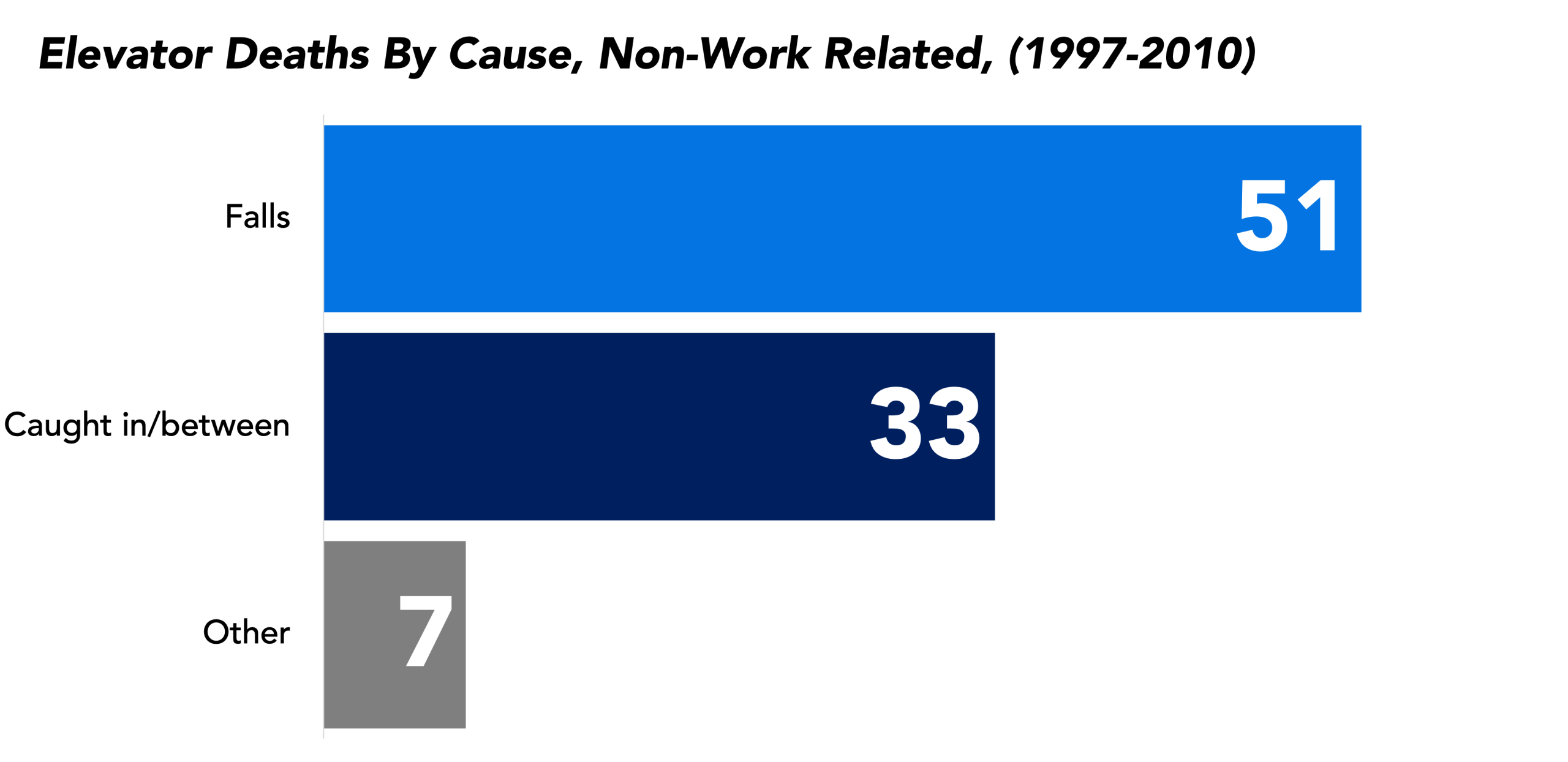
Between 1997 to 2010, there were 91 elevator deaths to non-work related persons. Falls caused over half the deaths during this period. About half of the falls were to the same level, especially while exiting the elevator. The rest of the falls occurred due to falls down the elevator shaft. Of the 91 deaths, sixteen victims were aged 10 or younger. Deaths categorized as “Other” include 4 struck-by-elevator deaths, 2 deaths due to elevator collapses, and 1 due to a heart attack after an elevator tremble.
Who Dies on Elevators?
According to a study conducted between 1992 and 2003, the yearly average of deaths involving elevators are as follows:
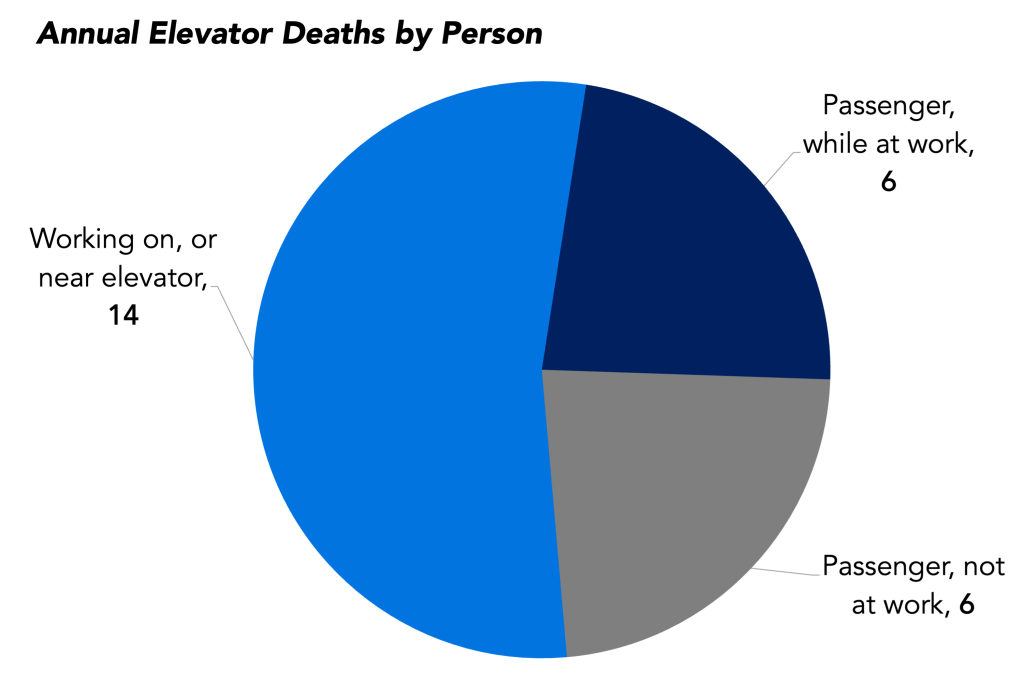
Passengers accounted for an average of 12 deaths per year, while those working on, or near elevators accounted for 14 deaths per year.
How Can Elevator Accidents Be Prevented?
Employers and property owners bear much of the burden in preventing elevator accidents. According to the CDC, they can do so by:
- De-energizing and locking out electrical circuits and mechanical equipment when elevators are out of service or being repaired
- Implementing a permit-required confined space program that outlines safety procedures for work inside elevator shafts
- Providing employees with fall protection
- Establishing an adequate elevator inspection and maintenance program
- Eliminating entrapment hazards
- Using only qualified workers with established training
Surprising Statistics on Elevator Accidents
Both passengers and workers are at risk of experiencing accidents while riding or working on or near elevators. Most elevator injuries do not occur from falling elevators but from passenger falls inside the elevator due to sudden drops or rises, elevator door accidents due to faulty rebound devices and sensor failures, and gaps between floors when an elevator mislevels. Accidents also occur to maintenance workers repairing elevators and elevator shafts. The following elevator accident statistics indicate the scope of the problem:
- Around 900,000 elevators are operating in the U.S., making about 18 billion trips per year
- Around 30 people die in the U.S. each year due to elevator accidents, and over 17,000 suffer injuries
- About half of elevator accident deaths and injuries occur to workers installing or maintaining elevators and shafts
- Half of elevator worker deaths were due to falling into elevator shafts
- Many serious elevator accident injuries occur as “caught-between” accidents when passengers or workers are caught, trapped, or pulled between the moving parts of an elevator or between gaps
- “Struck-by’’ elevator accidents also occur to workers hit by a descending elevator while working in a shaft
- Elevator installers and repair workers have the sixth-highest workplace death rate in the construction and repair trades, with an average death rate of just over 29 deaths per 100,000 full-time workers
- Ten deaths in a 2006 study occurred to untrained building maintenance workers attempting to unjam stalled elevators
- During the same study, three elevator worker deaths were electrocutions
- An eleven-year study revealed 68 elevator passenger deaths in the U.S. or an average of 6 passenger deaths per year
- Children are the most common elevator passengers to suffer injuries
- There were 117,100 recalled elevators in 2022 due to child entrapment hazards
Around 2,000 deaths per year occur in accidents on stairs, compared to 30 elevator accident deaths per year.

Who Is Responsible For Elevator Hazards?
According to the Consumer Product Safety Commission, they are making progress in holding manufacturers accountable for elevator hazards, but determining liability for an elevator accident injury isn’t always that simple. Depending on how the injury occurred and who it happened to, the injury victim could recover compensation through a defective product claim, an inadequate maintenance claim against a property owner, or a workplace injury claim. Calling and collaborating with a St. Louis personal injury lawyer can help guide victims through the legal process and receive compensation faster.
Frequently Asked Questions About Elevator Accidents
Are elevator accidents common in the United States?
Elevator accidents are relatively uncommon when compared to other everyday hazards, but they do happen more often than many people realize. Most incidents do not involve dramatic falls but instead stem from door malfunctions, mis-leveling, or sudden movements that cause passengers to lose their balance.
Do elevators ever actually fall like they do in movies?
Modern elevators do not freefall in the way movies often portray. Since the early 20th century, safety technology such as multiple steel cables, emergency braking systems, and shaft stoppers has made catastrophic falls virtually impossible. While elevators can still malfunction, these failures usually involve jerking movements, stops between floors, or door-related issues rather than plunging down a shaft.
What are the most common causes of elevator related deaths?
The most frequent fatalities occur when passengers trip or fall due to uneven leveling between the elevator car and the floor. Door-related injuries are also common, especially when sensors fail to detect people or objects in the doorway. For workers, serious injuries often involve falls into elevator shafts, caught-between accidents, or being struck by moving equipment during installation or maintenance.
Who is most at risk of being injured in an elevator accident?
Elevator workers face the highest risk, particularly those installing, repairing, or maintaining elevator systems. These workers are often exposed to open shafts, electrical systems, and heavy machinery. Among passengers, children and older adults are more likely to suffer injuries due to slower reaction times, balance issues, or getting caught in doors.
Are elevator accidents usually caused by mechanical failure?
Mechanical failure is one cause, but many elevator accidents result from improper maintenance or human error. Skipped inspections, failure to repair known issues, and ignoring warning signs significantly increase the likelihood of accidents. In workplace settings, accidents often occur when proper lockout procedures or fall protection measures are not followed.
Can elevator accidents be prevented?
Most elevator accidents are preventable with regular inspections, proper maintenance, and strict adherence to safety protocols. Employers and property owners play a critical role by ensuring elevators are serviced by qualified professionals and that workers are trained to follow confined space and fall protection procedures. Clear warning signage and prompt repairs also reduce risks for passengers.
Who is legally responsible for an elevator accident?
Responsibility depends on the circumstances surrounding the accident. A property owner may be liable if poor maintenance or unsafe conditions contributed to the injury. Manufacturers can be held accountable for defective elevator components, while employers may be responsible for workplace-related accidents involving elevator workers. Determining liability often requires a detailed investigation into maintenance records, safety practices, and equipment design.
What should someone do after being injured in an elevator accident?
Anyone injured in an elevator accident should seek medical attention immediately, even if injuries seem minor at first. Reporting the incident to the property owner or building management is important, as is documenting the conditions that caused the injury if possible. Consulting with a personal injury attorney can help injured individuals understand their rights and determine whether compensation may be available.
Do elevator recalls actually improve safety?
Elevator recalls play a significant role in improving safety, especially when hazards involve children or door entrapment risks. Recalls force manufacturers and property owners to address known defects before additional injuries occur. However, recalls are only effective when building owners take prompt action to repair or replace affected equipment.